Biology I - Article Abstract 4 – 25
Points
INSTRUCTIONS: Read this article and outline
its important points by answering the questions at the bottom.
-----------------------------------------------------------------------------------------------------------------------------
Stephen Hawking: "Humans Have Entered a New
Stage of Evolution" by Casey Kazan, July 3rd, 2009, in The Daily Galaxy.
http://www.dailygalaxy.com/my_weblog/2009/07/stephen-hawking-the-planet-has-entered-a-new-phase-of-evolution.html
Although it has taken Homo sapiens several
million years to evolve from the apes, the useful information in our DNA, has
probably changed by only a few million bits. So the rate of biological
evolution in humans, Stephen Hawking points out in his Life in the Universe
lecture, is about a bit a year.
"By contrast,"
Hawking says, "there are about 50,000 new books published in the English
language each year, containing of the order of a hundred billion bits of
information. Of course, the great majority of this information is garbage, and
no use to any form of life. But, even so, the rate at which useful information
can be added is millions, if not billions, higher than with DNA."
This means Hawking says that
we have entered a new phase of evolution. "At first, evolution proceeded
by natural selection, from random mutations. This Darwinian phase, lasted about
three and a half billion years, and produced us, beings who developed language,
to exchange information."
But what distinguishes us
from our cave man ancestors is the knowledge that we have accumulated over the
last ten thousand years, and particularly, Hawking points out, over the last
three hundred.
"I think it is
legitimate to take a broader view, and include externally transmitted
information, as well as DNA, in the evolution of the human race," Hawking
said.
In the last ten thousand
years the human species has been in what Hawking calls, "an external
transmission phase," where the internal record of information, handed down
to succeeding generations in DNA, has not changed significantly. "But the
external record, in books, and other long lasting forms of storage,"
Hawking says, "has grown enormously. Some people would use the term,
evolution, only for the internally transmitted genetic material, and would object
to it being applied to information handed down externally. But I think that is
too narrow a view. We are more than just our genes."
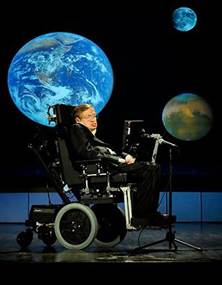 The time scale for evolution, in the
external transmission period, has collapsed to about 50 years, or less.
The time scale for evolution, in the
external transmission period, has collapsed to about 50 years, or less.
Meanwhile, Hawking observes,
our human brains "with which we process this information have evolved only
on the Darwinian time scale, of hundreds of thousands of years. This is
beginning to cause problems. In the 18th century, there was said to be a man
who had read every book written. But nowadays, if you read one book a day, it
would take you about 15,000 years to read through the books in a national
Library. By which time, many more books would have been written."
But we are now entering a new
phase, of what Hawking calls "self designed evolution," in which we
will be able to change and improve our DNA. "At first," he continues
"these changes will be confined to the repair of genetic defects, like
cystic fibrosis, and muscular dystrophy. These are controlled by single genes,
and so are fairly easy to identify, and correct.
Other qualities, such as
intelligence, are probably controlled by a large number of genes. It will be
much more difficult to find them, and work out the relations between them.
Nevertheless, I am sure that during the next century, people will discover how
to modify both intelligence, and instincts like aggression."
If the human race manages to
redesign itself, to reduce or eliminate the risk of self-destruction, we will
probably reach out to the stars and colonize other planets. But this will be
done, Hawking believes, with intelligent machines based on mechanical and
electronic components, rather than macromolecules, which could eventually
replace DNA based life, just as DNA may have replaced an earlier form of life.
-----------------------------------------------------------------------------------------------------------------------------
ANSWER
THE QUESTIONS BELOW
1. List the
title of the article, the author, where it was published, and the date it was
published.
2. What are Homo sapiens? Name me one individual of
this species that you know of.
3. What does
Stephen Hawking say about the difference between biological evolution and the
evolution of our body of knowledge, as represented in books, or through
“cultural evolution?”
4. If you
read one book a day, how long would it take you to read through all the books
in a national library?
5. What is “self
designed evolution?"